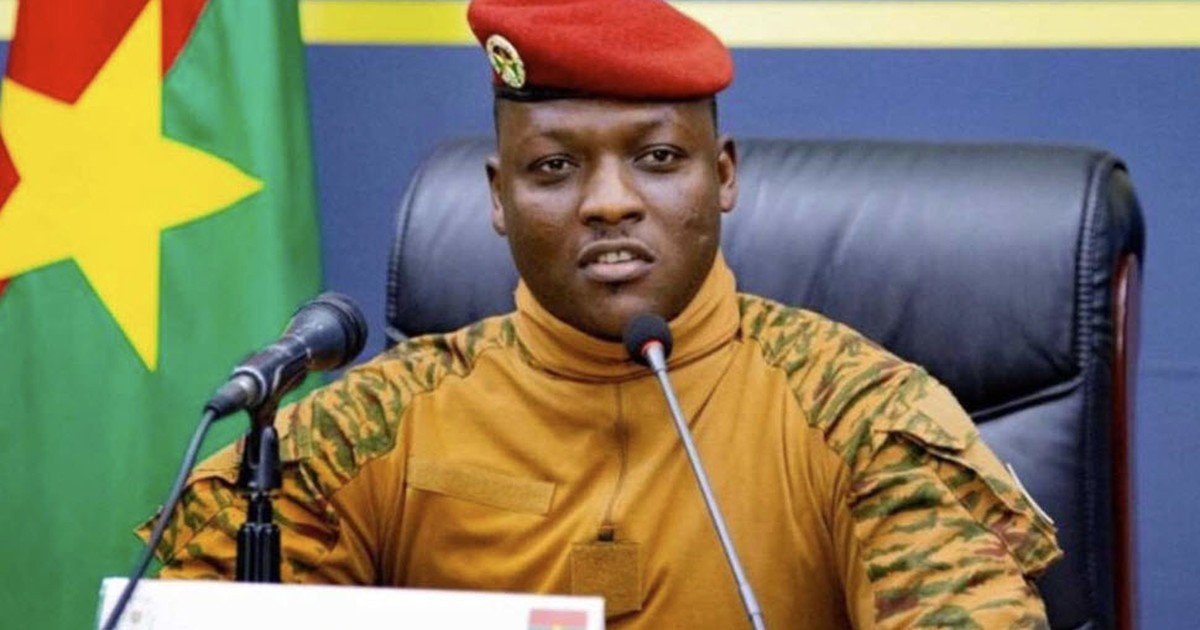
On July 16, Captain Ibrahim Traoré traveled to Ouahigouya, in Burkina Faso's Yaadga region, to address the Forces Vives — the traditional and religious leaders whose blessing still matters in the north. He used the platform for two things at once, and the pairing was not an accident.
The first was religion. Traoré told the gathering that the constitution stands above every faith, that "radical Islam" has no place in Burkina Faso, and that preachers who spread extremism would be suspended from the pulpit. He went further than he had before: he claimed his government had identified more than 800 Burkinabè studying Islamic law in Arab countries, outside the knowledge of Burkina Faso's own diplomatic missions, and threatened to strip the citizenship of any who refused to come home.
The second was power. "There can't be two captains on one ship," he told the same audience. Everyone who works with him, he said, knows how he operates — and if anyone steps out of line, he will deal with them without hesitation. There are no strongmen around him.
Two messages, one afternoon, one stage. The rest of this dispatch is an argument that they were never really two messages at all.
An Imam Named Kindo
The religious rift did not begin in July. It began in March, when Traoré's cabinet adopted a draft Religious Freedoms Law aimed, officials said, at reinforcing the secular character of the state. Sometime around the end of that month, Imam Mahmoud Barro of Bobo-Dioulasso — Burkina Faso's second city — disappeared after publicly criticizing the bill. His family has had no official word on his whereabouts since.
In late May, security forces arrested a bigger name: Dr. Mohamed Ishaq Kindo, vice-president of the Sunni Movement of Burkina Faso and one of the country's most prominent Islamic scholars, two days after he too criticized the draft law. His supporters gathered at Ouagadougou's largest Sunni mosque to demand his release. Authorities closed the mosque indefinitely, calling it a public-order risk, and transferred close to 100 of Kindo's supporters to a military camp for what officials called "civic training." Parliament passed the Religious Freedoms Law regardless, unanimously, on June 20.
Traoré has not been quiet about Kindo since. He told the July 16 crowd the imam was "fundamentally bad" and accused him of building an "Islamic police force" back in 2019 — the language of a man who sees an organized rival, not a wayward preacher.
That detail matters more than it first appears. Hold it.
Two Empty Offices
Here is the story that international wire services only began reporting in earnest in the last week of July, and it changes how the imam story should be read.
Burkina Faso's junta has an official second-in-command: Oumarou Yabré, who runs both the National Intelligence Agency and the National Security Council — by most accounts the single most powerful security official in the country after Traoré himself. Yabré has not been seen in public since late May. He has stopped going to his own office. The security detail at his residence has been quietly reduced. He was absent from the presidency's traditional flag-raising ceremony, which he normally attends, and from a recent ceremony promoting three officers to general.
The junta's third-in-command has vanished on the same timeline. Farouk Azaria Sorgho — the officer who read Burkina Faso's coup announcement on state television back in September 2022, and who has spent the past year as the government's anti-corruption enforcer, publicly naming officials for financial misconduct — has not appeared since mid-May. He commands one of Ouagadougou's Rapid Intervention Battalions; his deputy has been running it in his absence. Security officials, speaking anonymously, allege Sorgho was "abducted" — not by rivals of the regime, but by people close to Traoré himself. No one in government has offered an official explanation. His father, a former infrastructure minister, was separately arrested and then reportedly taken by armed men.
On June 17, two officials close to Yabré — the head of the state hydrocarbons company and a ministerial adviser — were removed by presidential decree. And Yabré's own circle has said that several of his associates have been swept up in the wider crackdown, explicitly naming one of them: Imam Ishaq Kindo.
Read that sentence again. The scholar Traoré calls "fundamentally bad" for building his own power base is, according to people close to the missing intelligence chief, one of Yabré's people.
Reported tension between Traoré and Yabré goes back to 2023, and was denied by both sides at the time. It is harder to deny an empty office.
The Rumor With No Byline
This is the part of the story that deserves a direct answer rather than a hedge.
A date is circulating on social media and in diaspora channels: August 4, the day some online posts claim Traoré's rule will end. I looked for this claim in wire reporting — AFP, Reuters, Al Jazeera, Africanews — and found none of it there. What I found instead was a genre: Burkina Faso's government has announced roughly two dozen "foiled coup plots" since 2022, most recently on January 3 of this year, when the security minister said an assassination attempt and a strike on a military drone base had been narrowly prevented, and blamed the exiled former president, Paul-Henri Damiba.
Damiba is no longer in a position to mastermind anything from exile. Togo arrested him in mid-January and extradited him to Ouagadougou, where he now sits in Burkinabè custody facing charges of embezzlement and corruption — not, notably, a formal coup charge. The government's habitual external bogeyman is in its own jail cell.
So: should August 4 be taken seriously? As a specific date with a specific plot behind it, I have found no credible evidence that it should. It fits a well-worn pattern of unverifiable claims in a country whose government has strong incentives — legitimacy, mobilization, cover for further crackdowns — to keep the coup narrative alive, and whose diaspora opposition has equally strong incentives to keep hope alive. Neither side's claims should be taken at face value.
But the vacuum the rumor is rushing to fill is real, verified by multiple independent wire services, and does not need a rumor to be alarming. A president publicly warning his own government there is only one captain, delivered days after his second- and third-in-command went dark simultaneously, is a fact. The date attached to it is not.
The War That Isn't Pausing
While Ouagadougou has been consumed by its own succession anxiety, the war outside the palace has not waited politely.
Jihadist groups — principally JNIM, al-Qaeda's regional affiliate, alongside the Islamic State's Sahel branch — now hold operational control over an estimated 60 percent of Burkina Faso's territory, effectively encircling the capital. JNIM alone conducted more than 500 attacks in the country in 2025. In the Global Terrorism Index published this March, Burkina Faso was overtaken for the first time since the index began tracking it as the world's most-affected country — displaced narrowly into second place by Pakistan — though recorded deaths actually fell by 45 percent year-on-year, a paradox that analysts attribute partly to a shift in jihadist tactics toward economic strangulation over mass-casualty attacks, and partly to a media environment in which independent verification of casualty figures has become close to impossible.
This is the context in which Traoré chose, this month, to open a confrontation with part of the religious establishment. It is fair to ask whether that was wise.
The Patron Who Doesn't Take Sides
One more actor deserves a place in this picture: Russia. Since early 2024, Africa Corps troops have been stationed in Burkina Faso, reinforced periodically, alongside a personal security detail assigned specifically to Traoré, a wheat-aid package, and a nuclear-energy cooperation agreement signed at the St. Petersburg forum last year. Moscow's third Russia-Africa summit is scheduled for late October, with more than thirty African states already confirmed.
Would Moscow move to prop Traoré up personally if the internal rupture sharpened? The honest answer is that Russia's investment so far has been transactional and institutional — access to a compliant Sahelian state, a foothold against French and Western influence, a market for its nuclear and defense export ambitions — rather than a personal bet on one captain over another. The personal security detail is the strongest evidence of a specific stake in Traoré individually rather than in the junta as an abstraction, but Africa Corps has shown no history of trying to arbitrate internal disputes among its client regimes; it has historically backed whoever holds the palace, not whoever held it yesterday. If Yabré or Sorgho's absence resolves in Traoré's favor, expect Moscow's position to be indifferent to how it resolved. If it doesn't, expect Moscow to recalculate quickly and without sentiment.
Worth noting in passing: the same month Traoré escalated his rhetoric against "radical Islam," his government also received Israel's first resident ambassador to Ouagadougou, part of a broader deepening of Israeli security-technology cooperation with the Alliance of Sahel States. A leader who spent his first three years in power building an anti-Western, anti-colonial brand is now hedging that brand with Tel Aviv and, evidently, with a purge closer to home. None of these moves are contradictions in isolation. Together, they describe a leader triangulating harder than his public image admits.
One War, Not Three
The question worth asking is whether Traoré was politically naive to inflame religious sentiment while his hands were already full with jihadists and a leadership challenge. I don't think naive is the right word, and I don't think "three fronts" is the right count.
If Kindo is genuinely part of Yabré's network — and that claim comes from people close to Yabré himself, not from government propaganda, which makes it more credible, not less — then the religious crackdown was never a second front opened alongside the power struggle. It was the power struggle, fought on terrain where Traoré holds every institutional advantage: he controls the security services that make arrests, the state broadcaster that frames the narrative, and now a religious-freedoms law that gives legal cover to actions that would otherwise look like naked suppression of a rival's civilian base. Going after "extremist preachers" is a far more defensible public message than going after his own intelligence chief's allies by name.
Seen this way, Traoré has not overextended himself across three battles. He is running two: the one against JNIM and the Islamic State's Sahel branch, which he did not choose and cannot avoid, and the one for control of his own government, which he did choose, and in which the mosque closures, the imam arrests, and the citizenship threats are not a distraction from the main event. They are the main event's opening moves.
That does not make the gambit safe. Kindo's arrest cost Traoré something real — the tacit backing of Sunni scholars who had helped legitimize the junta since 2022, according to Sahel researchers who track the relationship closely. A leader consolidating internal control by alienating a domestic constituency he still needs, at the exact moment JNIM is testing whether Ouagadougou's attention has wandered, is not naive. It is a leader making a calculated bet that the internal threat is more dangerous than the reputational cost — and he may be right. Yabré ran the agency that reads Traoré's mail. An intelligence chief who goes quiet is a different order of danger than a mosque that closes.
The August 4 date is noise, not signal — treat it as such until wire services, not Telegram channels, say otherwise.
The empty offices in Ouagadougou are signal.
And the imams under arrest may not be a religious story wearing a security disguise. They may be a security story that found it useful to wear a religious one.
Sources: Al Jazeera, AFP (via Vanguard, Africanews, Taipei Times, allAfrica), Media Foundation for West Africa / IFEX, Africa Defense Forum, Institute for Economics and Peace (Global Terrorism Index 2026), Critical Threats Project, Jamestown Foundation, Reuters, Africa Center for Strategic Studies.